The growing pressures on Britain’s transport system may ultimately strengthen the case for localism.
For most of the industrial era, the economy depended upon cheap transport:
cheap diesel
expanding road systems
large freight movements
centralised warehousing
mass commuting
national retail chains
long-distance food distribution
This allowed Britain to organise economic life on an increasingly large scale.
Food travelled hundreds of miles. People commuted long distances daily. Goods crossed the country overnight. Large urban centres absorbed workers from vast surrounding areas.
But all of this depended upon abundant surplus energy and affordable transport costs.
As diesel prices rise and the wider economy weakens, that model becomes progressively harder to sustain.
Heavy goods transport is particularly vulnerable because fuel is one of the largest costs for haulage firms. Some small operators already struggle with fuel costs and narrowing margins. At the same time, rail freight also faces rising energy and infrastructure costs because large parts of the railway system still depend upon diesel locomotives or expensive electrification.
Governments may attempt to support both road and rail systems through subsidy, but government itself faces growing financial pressures:
debt interest
welfare spending
NHS costs
infrastructure maintenance
ageing population costs
There are therefore limits to how much support can be provided indefinitely.
At the same time, households increasingly cannot afford continual increases in:
transport fares
fuel prices
delivery costs
energy bills
general living costs
The result may gradually become a contraction in transport demand itself.
This is especially important because much of Britain’s urban economy appears connected to discretionary activity:
hospitality
tourism
leisure
office administration
non-essential retail
entertainment
advertising
consumer finance
If discretionary spending weakens, associated travel and freight movement also weaken.
This is where localism becomes increasingly important.
Localism reduces dependence upon large-scale transport systems because more activity occurs nearer to where people live.
Instead of:
national food chains
long-distance commuting
centralised production
massive warehousing systems
a localist economy increasingly depends upon:
local food production
nearby employment
local repair
smaller distribution systems
shorter supply chains
walking and cycling where possible
essential rather than discretionary movement
In this context, localism is not simply an environmental preference or political theory.
It may become an economic adaptation to rising transport costs and declining surplus energy.
The implications are profound.
Large supermarkets depend upon huge distribution networks and constant freight movement. Urban office economies depend upon mass commuting. Online retail depends upon extensive delivery systems. Tourism depends upon discretionary travel affordability.
If transport costs continue rising while real incomes weaken, these systems become progressively more fragile.
communities become less dependent upon national logistics
local work reduces commuting demand
repair and reuse reduce freight demand
smaller local economies require less movement of goods overall
This does not mean the complete disappearance of national transport systems.
Britain will still require:
rail freight corridors
essential road freight
ports
strategic railways
specialist distribution systems
national infrastructure
But the balance may gradually shift.
The industrial growth economy assumed ever-increasing movement: more goods, more travel, more commuting, more consumption.
A shrinking economy increasingly encourages the reverse:
localisation
simplification
shorter supply chains
reduced discretionary movement
greater emphasis upon essentials
Under those conditions, localism may evolve not through ideology alone, but because it increasingly fits the economic realities of a society facing rising energy costs and declining transport affordability.
I’ll cut to the chase. The Trump-Epstein-Netanyahu War could cause more deaths than any war in history, including World War II. This will not be via its direct casualties, but via deaths caused by its economic and agricultural consequences across the planet. For someone who exalts in superlatives, Trump may be responsible for causing more deaths than any previous tyrant in human history.
Help overcome the delusions of conventional wisdom by sharing this post
This is because the world economic system resembles Trump himself: its self-image is one of robust power, but its inner nature is one of incredible fragility. One month ago, many people would not even have heard of the Strait of Hormuz—which Trump, in his bravado, has just referred to as “the Strait of Trump”. Now everyone knows where it is—if not precisely why it matters. We are about to learn the hard way, via the consequences of cutting off this vital artery in the global economy’s circulatory system.
This should have been common knowledge. But, just like Trump himself, our understanding of the global economy is based on an elaborate set of delusions. I am looking forward to the howls from mainstream “Neoclassical” economists when they hear that I blame most of those delusions on them.
Neoclassical economics has always lulled us into a false sense of security by its asinine assumption that most industries are “competitive”, as they define competition. A “competitive” industry, according to Neoclassical economics, is one in which there are a multitude of producers producing a homogeneous product. This definition is doubly delusional: most industries are dominated by a small number of very large firms; and all products are highly differentiated.
In the Neoclassical world, taking out a few producers would have only a trivial impact on total production, because there are thousands—millions!—of producers, and every producer’s output is a perfect substitute for all other producers’ output. In the real world, most industries are dominated by a handful of large firms, and one firm’s output cannot be easily substituted for another.
We are now finding this out the hard way in the TEN War: Venezuelan oil cannot replace oil from the Persian Gulf, and the key facilities which have been damaged—such as Qatar’s LNG processing plants—can only be repaired by a handful of companies.
Worse, those repairs will take years, whereas the canonical “supply and demand diagram” of Neoclassical economists completely ignores time. In the Neoclassical world, if you want to produce higher output, just increase the price and, hey presto, you move up the supply curve and produce a higher quantity.
In the real world, if you are 25 percent below the desired level of output of LNG—as the world is now, with not only the wartime destruction Qatar’s plants, but also the impact of tropical cyclone Narelle on Australia’s LNG plants—then it will take several years to move up that “supply curve”.
Neoclassical economics has also become an even worse guide to reality as time has gone on. Today, it is today almost totally divorced from the production system of the planet. But had this war been proposed in 1976 rather than 2026, Neoclassical Economists would have been much more aware of the disastrous impact of closing the Strait of Hormuz.
Fifty years ago, mainstream economics used what they called “Computable General Equilibrium” (CGE) models to represent our systems of production and distribution. Today, the dominant models are called “Dynamic Stochastic General Equilibrium” (DSGE). Mainstream economists are convinced that DSGE models are far more scientific than their CGE predecessors. In fact, they are far more delusional.
CGE models used what are called “Input-Output Matrices” to describe the production process. Rather like a cookbook which shows the ingredients needed to create many different meals, these matrices were arrays of numbers which showed how many units of commodities were needed to produce other commodities.
DSGE models have replaced this with a fantastical single equation (the “Cobb-Douglas Production Function”, as it’s known), which shows a single number—“Gross Domestic Product”—being produced by “Factors of Production”: Labour and Machinery alone (multiplied by what they call “Total Factor Productivity”). Labour and Machinery go into factories, and goods and services out the other end.
Neoclassical economists from 1976 would have been aware that cutting off the supply of some commodities would have flow-on effects on the output of all other commodities, because of the recipe nature of input-output matrices. Modern Neoclassical economists, however, are ignorant of the dependence of GDP on a huge range of commodity inputs, let alone on products from the natural world, like energy and raw materials.
Unfortunately, not only do Neoclassical economists normally ignore energy, but also when they do consider it, they trivialize its impact. One of the few Neoclassical papers to make an empirical prediction of the impact of a decline in energy inputs asserted that, according to the “Cobb-Douglas Production Function”, “a drop in energy supply of … 10% … reduces production by … 0.4%” (Bachmann et al. 2022).
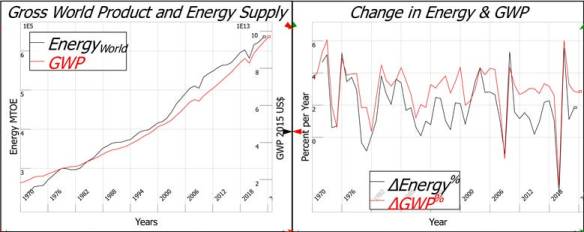
In fact, the relationship between energy and GDP is effectively 1 for 1: a 10% fall in energy causes a 10% fall in GDP, and vice-versa.
The fall in GDP from a fall in energy from the Strait of Hormuz is bad enough. But the fall in food output from the fall in fertilizer passing through the Strait is potentially far worse. Economists are unaware of the manner in which food is produced, and because they are, so is the general public. We don’t realise how dependent our food production is on petroleum and its by-products.
Fertilizer is created via the Haber-Bosch process, which takes inputs of natural gas (let’s call it by its real name: methane, or CH4), water, and atmospheric nitrogen, and produces ammonia (NH3), from which fertilizers like Urea are produced. Without this process, the carrying capacity of the planet would be about half the world’s current population.
Something of the order of 1/3rd of the world’s fertilizer output passes through the Strait of Hormuz—and because of the TED War, it is currently not passing through.
There is also a timing issue with fertilizer production. It has to be available when crops are planted; if it doesn’t arrive in time, then it can’t be added later. That raises the very real prospect of food output falling well below the level needed to keep everyone on the planet alive.
Historically, famines have affected Third World countries. This famine could affect First World ones, because if anything, food production in the USA and Europe is more dependent on fertilizer inputs than food production in Africa, Asia and Latin America.
Survival will depend on grain reserves. China has of the order of 18 months in reserve, which will insulate it from the disruptions of 2026. The USA and India have substantial reserves as well, but some countries—including the UK—have virtually none. Australia produces 5 times as much grain as it consumes, but its stocks would cover domestic consumption for less than a month.
If the worst comes to pass—if fertiliser supplies don’t reach farms in time—then food output outside the USA could fall well short of what is needed to keep the entire population alive. Famines will ensue, and even countries that have never experienced such events could be forced into food rationing. This includes the UK and Australia, and a patchwork of countries across Europe.
Other critical products that normally pass through the Strait of Hormuz include Helium, which is critical to the production of semiconductors, and sulphuric acid, which is critical to numerous production processes. The closure of the Strait cuts off one third of global helium output and about half of global sulphuric acid output.
With critical industrial inputs cut as well, the problems will cascade well past food alone—though that is clearly the most damaging impact. With LNG, petroleum, helium and sulphuric acid production cut, the capacity to undertake repairs to damaged facilities will also be hindered.
The TED War is rather like smashing a spider’s web—and then killing the spider. Spider’s silk is actually surprising strong: it is five times stronger than an equivalent width of steel. But if you smash it from the side, and then kill the spider, it goes from an effective means to catch insects to a useless mess of tangled fibre. That is what this War is doing to the production and distribution system of the planet. Hence the title of this post, which is taken from one of the great poems, “The Second Coming” by Yeats.
Fittingly, this powerful poem refers to Christian religious fantasies as well: “the Second Coming” and the birthplace of Christ, Bethlehem. But unlike the Christian Zionist fantasies that are part of why Americans fell for this foolish War in the first place, the creature born is not The Lord, but chaos:
Turning and turning in the widening gyre The falcon cannot hear the falconer; Things fall apart; the centre cannot hold; Mere anarchy is loosed upon the world, The blood-dimmed tide is loosed, and everywhere, The ceremony of innocence is drowned; The best lack all conviction, while the worst Are full of passionate intensity.
Surely some revelation is at hand; Surely the Second Coming is at hand. The Second Coming! Hardly are those words out When a vast image out of Spiritus Mundi Troubles my sight: somewhere in sands of the desert
A shape with lion body and the head of a man, A gaze blank and pitiless as the sun, Is moving its slow thighs, while all about it Reel shadows of the indignant desert birds. The darkness drops again; but now I know That twenty centuries of stony sleep Were vexed to nightmare by a rocking cradle,
And what rough beast, its hour come round at last, Slouches towards Bethlehem to be born?